


Many traders believe that success in swing trading comes from finding the “perfect strategy” or catching the exact entry moment.
The truth is much more boring.
Success comes from a well-structured daily routine, repeated with discipline, day after day, regardless of whether the market is in a bull or bear phase.
And here’s the best part: this routine doesn’t have to consume your entire day.
You don’t need to sit glued to the screen for 12 hours, staring at charts until your eyes burn.
A properly optimized process can take as little as 30 minutes to an hour of focused work, leaving the rest of the day free for whatever matters to you, whether that’s family, hobbies, a 9-to-5 job, the gym, or simply living your life.
That’s the whole point of swing trading.
It should fit around your life, not the other way around.
Over the past few years, I’ve refined my process until it became almost automatic, built specifically so it respects my time and my energy.
In this article, I’ll show you exactly what my trading day looks like, from the first scan in the morning to the market close, so you can build a routine that works around your schedule, not against it.
I promise you this article is packed with value, and if you implement a routine like this yourself, it will permanently change your trading performance, and more importantly, your quality of life as a trader.
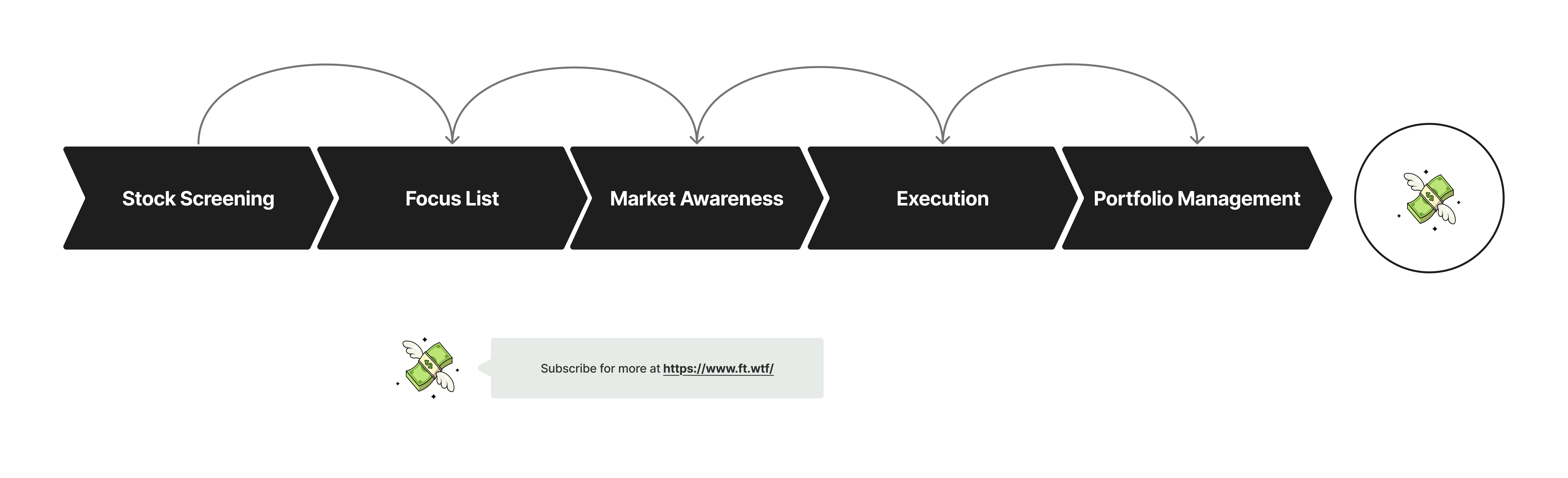
My daily routine is:
Stock screening
Focus list
Market awareness
Execution
Portfolio management
Now we’ll go through each one, and I’ll explain them in detail.
1. Stock Screening
This is the first step in the process and involves adding all results into a single watchlist.
I have 6 different scanners.
TradingView Freedom Trades Scanner: the scanner we use in the Freedom Trades strategy, which gives us the best growth stock opportunities. (I check this weekly)
My own scanner, coded with the help of AI, which uses a proprietary formula to grade opportunities and delivers the 10 best results daily. (I check this daily)
Hottest Stocks Screener (I check this daily)
CANSLIM Screener (I check this daily)
IPO Screener (I check this weekly)
Stocks near multi-year lows (I check this weekly)
And basically, I simply take all the results from these screeners and add them to today’s list.
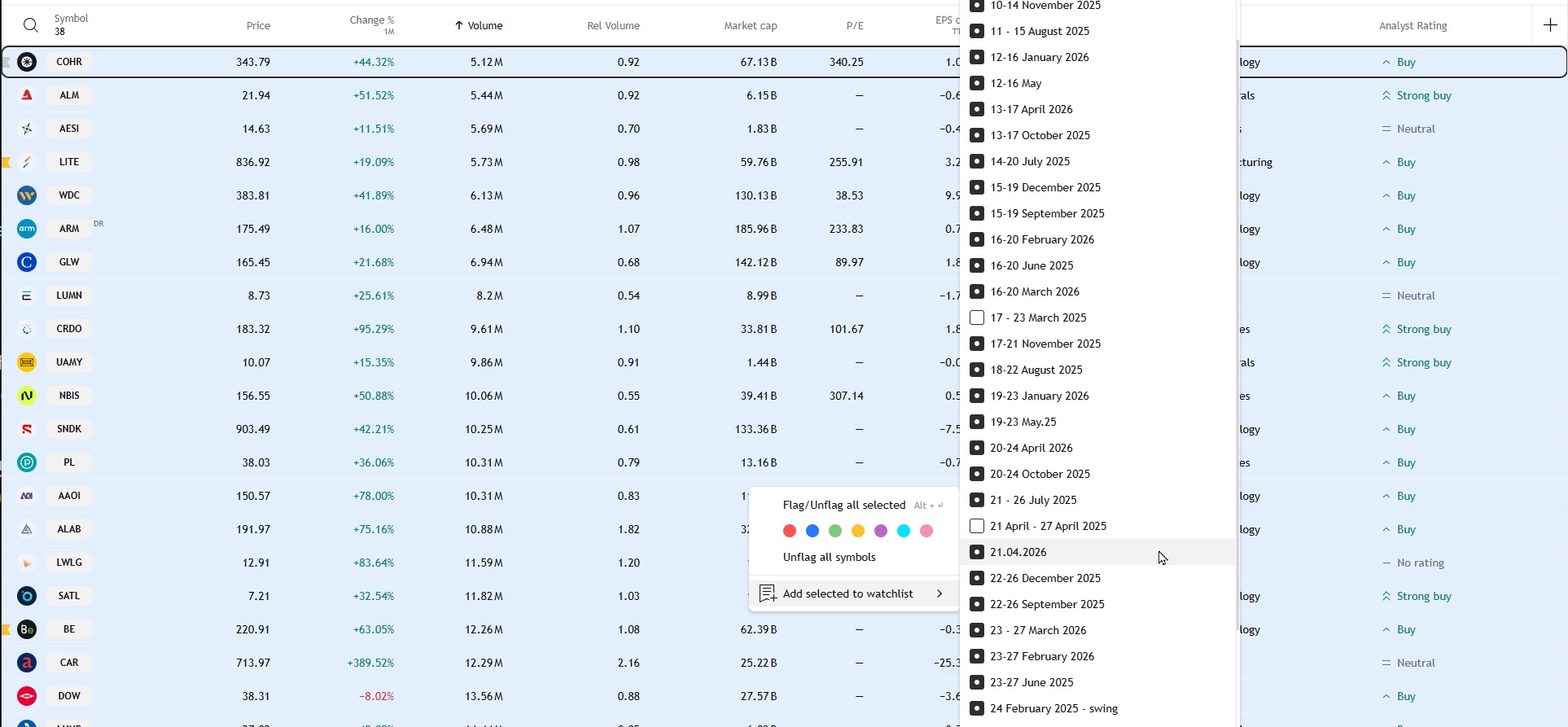
This will be the preliminary list. The number of tickers I’ll have at this point depends heavily on the general market. In a bull market, I can have 150 to 200 tickers to review, while in a bear market it can be 10 to 20 tickers max per day.
This is basically the part that takes the longest, because it involves me manually going through each ticker.
At the beginning, it will take you longer because you don’t know what to look for, but over time your brain and eye will develop, and you’ll immediately recognize what a winner looks like. (In the Freedom Trades strategy, I show you exactly what to look for.)
It sometimes takes me 30 minutes, other times 2 hours, depending on how hot the market is.
2. Daily Focus List
I add all the tickers I like from the preliminary watchlist into a watchlist called “Focus List.”
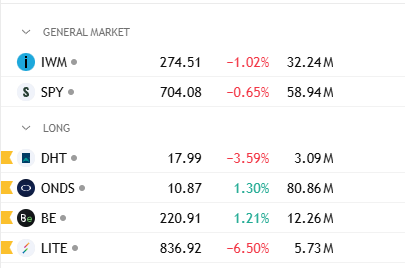
My limit is 6 tickers in this list.
You need to enforce this rule, otherwise you’ll end up piling a bunch of them in here.
This is very important, as it will affect your execution if you have too many.
You know the saying: if you try to catch two rabbits at once, you won’t catch either one.
3. Market Awareness
This is a very important step, because this step determines whether or not you’ll execute today, and whether or not you’ll be aggressive.
Basically, in this step we’re trying to judge whether we’re in a favorable environment for trading or not.
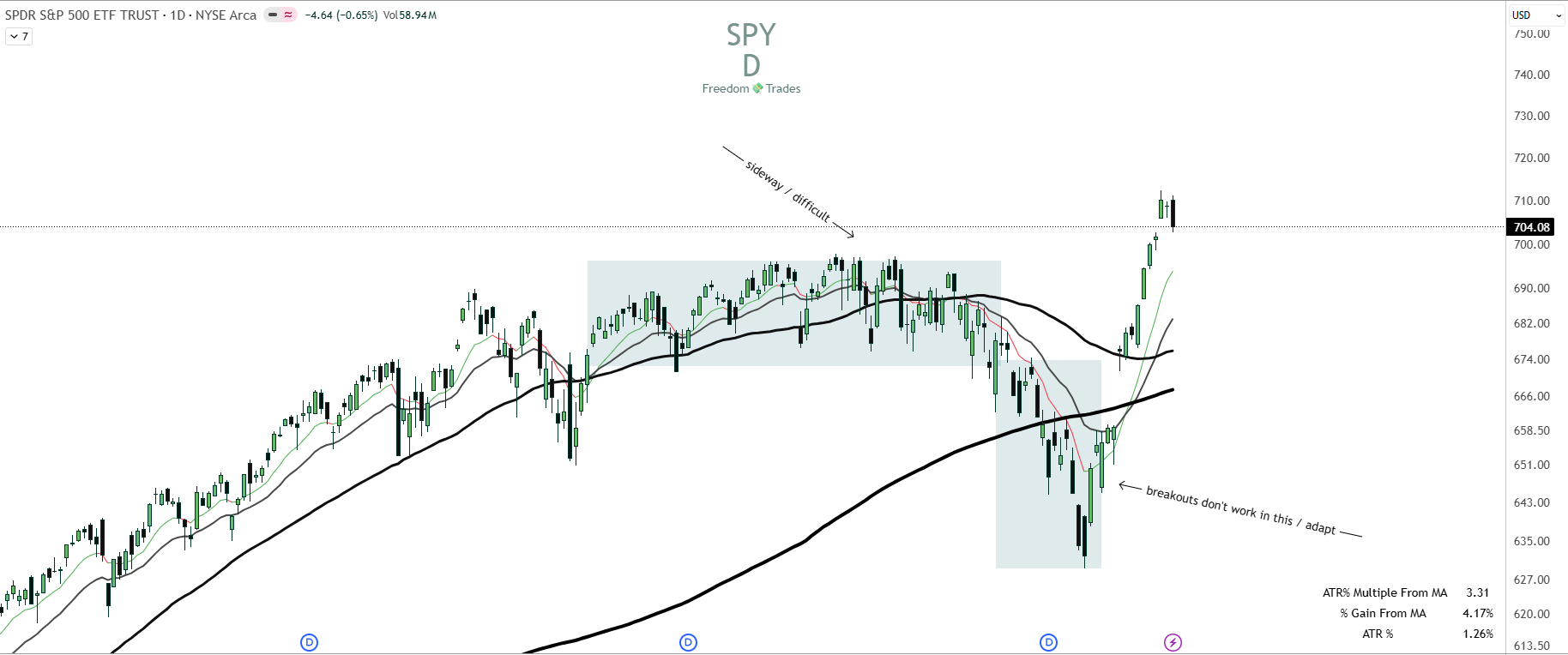
I can tell you right now that from November 2025 to March 2026, it was a very tough environment for swing trading.
The smartest thing you could have done was either reduce size or stay completely in cash.
Then in April, everything became easy again, and that was the moment to push.
As we know from the statistics, 3 out of 4 stocks follow the general market.
So remember: General market > Setup.
How I Identify the General Market
Also with the help of a screener in TradingView.
Here, you can add them too.
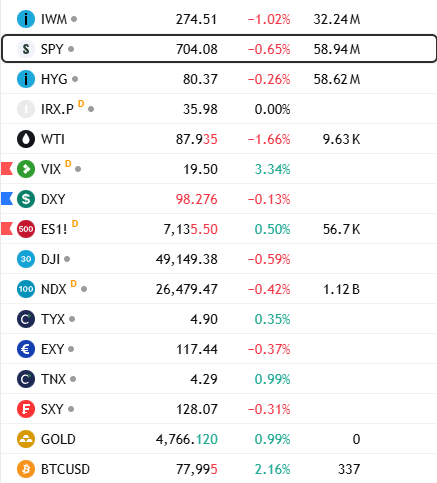
I check all of these to see where they stand.
What are the general indexes doing?
Are they above the 200MA? What about the 50MA? The 20MA?
In general, use the 200MA for the long-term trend, the 50MA for the medium-term trend, and the 20MA for the short-term trend.
Check the VIX
The VIX (Volatility Index) is the market’s “fear gauge.” It measures the expected volatility of the S&P 500 over the next 30 days, calculated from options prices.
Below 15 is the perfect trading environment: low volatility, stable trends.
Between 15 and 20, volatility is normal.
20 to 25, be careful. Many of your trades will get stopped out due to volatility.
Above 25, I’d sit tight. I wouldn’t open any new positions and would wait for a more favorable environment.
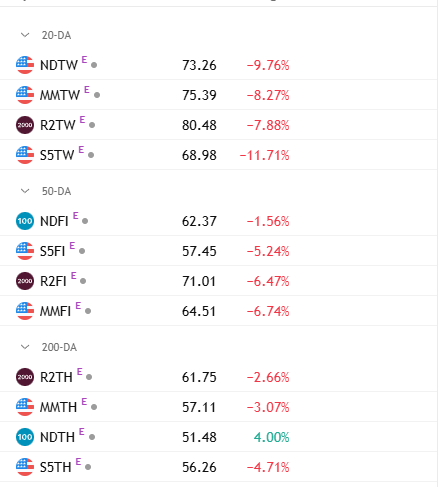
Check Market Breadth
Market breadth is an indicator that measures how many stocks are actually participating in a market move, not just what the major indexes like the S&P 500 or Nasdaq are doing.
Think of the market like a team. If the index is going up but only 5 to 10 mega-cap stocks (Nvidia, Apple, Microsoft) are pulling everything higher, the team looks strong, but it’s fragile. If small and mid caps are rising together with the large caps, the trend has a solid foundation.
It’s completely free and you can do it in TradingView. Copy these tickers.
Check the Sectors
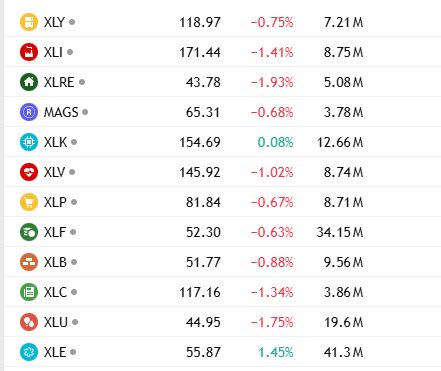
And the last step is to check which sectors are performing the best, so I can figure out where I should focus.
Checking sectors is essential for swing trading because it shows you where institutional money is flowing in the market and what the real market “regime” is, beyond what the major indexes show.
Copy all the tickers from here into a watchlist.
4. Execution
It’s time to execute.
And you’ve probably figured it out, but at this point you should be confident about what you’re going to trade today.
All of these steps are meant to make you feel confident and prepared.
Because “with preparation comes opportunity,” or as I like to say, “luck is what happens when preparation meets opportunity.”
And in this part, I like to have zero discretionary component.
I execute purely mechanically, according to the Freedom Trades strategy.
If in the screening or market awareness parts you could say there’s a discretionary side, that it’s not always black or white, well in the execution part it’s purely mechanical.
If this happens, execute that.
To give a specific example: if the stock, on the daily time frame, breaks above the previous high, I execute a 5-minute ORB with stop loss at LOD and risk 0.40% per trade.
And what’s cool about this is, if you remove the discretionary component from execution, the emotions disappear.
It’s just a matter of following instructions.
Everything is clear.
Discipline becomes much easier.
I execute 99% of my trades within the first hour of the market open.
5. Portfolio Management
At this point, the first hour after the open has passed, and now comes the easiest part of the day. At this stage, it’s all about taking profits.
I don’t have anything to manage when it comes to stop losses, because they’re already set in place from the moment I executed the trade.
This is the most relaxed part, because:
Profitable positions manage themselves; losses are what we have to manage.
And since we like to let our winners run, that means you don’t have to be glued to your screen all day.
That’s the point of swing trading: to have free time.
To use that free time for whatever you want, whether it’s spending time with your family, hobbies, a 9-to-5 job, etc.
Your Next Step
You’ve probably figured it out by now, but the most important part is what you do after the market closes.
Meaning, after you get home from work, spend 30 minutes to an hour filtering stocks and studying the market, then the next day execute those ideas, and then job done.
Simple on paper, harder in practice. Because doing this alone, without a clear strategy, without the right scanners, and without people to keep you accountable, is exactly why most traders give up in the first 6 months.
That’s why we built Freedom Trades. You get the full strategy, my scanners, real-time trade alerts, weekly market analysis, and a community of traders running the exact same routine.
Right now, the yearly plan is 49% cheaper than the monthly one, so if you’re serious about building this routine for the long run, this is the moment to lock it in.
We’re waiting for you inside.
Trade Setups of The Week
High Probability Trades for 20 - 24 April 2026

This week’s PRO report breaks down my full momentum stock watchlist, including the setups I’m watching.
You’ll see my portfolio, my open positions, and the exact stocks I’m targeting.. all based on the same swing trading system.
If you want to trade smarter ,not longer , and get my weekly watchlist with setups, and portfolio breakdowns, this one’s for you.
Copy My Watchlist for next week
Here are the stocks, sectors, or trends I’m watching closely.
Access my entire watchlist for free here:
My watchlist
Want more than just a watchlist?
Get an understanding of the screener, so you know exactly what to watch.
Gain access to my trading strategy!
Join a community of like-minded individuals who are committed to achieving financial freedom and taking control of their future.
Upgrade now to get the full experience!
If you think this newsletter could help your friends, share it with them so it can reach as many traders as possible.
And here’s the fun part: when you share it, you can unlock special rewards + you will look smart in front of your friends :)
“One trade closer to freedom.”
Vladislav
Hello. do you have similar screeners for Finviz? Thanks
Hi! Thanks for giving insight into your process. Does your subscription give suggested trade entries, exits, and stop losses? Do you update stop losses if things go up or down? Thanks!