


My dream, and probably yours too, was to become a full-time swing trader.
To be free.
To not have anyone else set my schedule.
To be in control of my own life.
For me, that happened in January 2026.
BUT
It wasn’t easy.
And it comes with some hidden challenges.
Today, I’m going to show you exactly what you need and some IMPORTANT criteria you need to keep in mind before taking this step.
What Nobody Ever Talks About in Trading
Unfortunately, there’s a major difference between trading full time and living off your trading profits.
And this isn’t mentioned anywhere in the courses that influencers are trying to sell.
You can start trading full-time relatively easily and early on.
But making a living off your trading profits takes many more years and a lot more capital.
How much money you actually need to live off your trading profits
Let’s start with the second most important thing
CAPITAL
Well, this amount is entirely personal.
That is to say
It depends on your fixed and variable costs.
But don’t worry…I won’t leave you hanging.
We’ll run some simulations, and I’ll show you exactly how to calculate how much capital you need.
To run this simulation, we’ll use an average U.S. city as our example.
That is, not the most expensive, but not the cheapest either, in terms of living costs.
Based on current 2025–2026 data from the U.S. Bureau of Labor Statistics, Numbeo, and cost-of-living studies, here is the individual annual cost for a single man living in a medium-cost U.S. city (Columbus OH, Indianapolis IN, Pittsburgh PA, Oklahoma City OK)

Let’s take the moderate scenario and say your living expenses are $60,000.
Now we need to calculate how much capital you need to make a living from full-time swing trading.
My recommendation is to never risk more than 5% of your total capital… otherwise, it will eat into your equity curve, and you’ll never be able to grow that account.
Especially in the beginning.
later on, you can become more aggressive depending on your goals, age, etc.
Okay, here comes the hard part.
It’s probably going to hurt when you see this.
But let’s assume you have an average return of 20%.
Which is extraordinary, by the way.
And let’s take 25% of the profits. (Not from the account, but from the profits.)
Core formula
Annual return: 20%
Profit per year: 0.20×Capital0.20×Capital
Withdrawal: 25% of profit
Target withdrawal: $60,000/year
So:
With a 20% annual return and withdrawing 25% of your profits each year, you need about $1,200,000 starting capital to pull out $60,000 per year.
I know this is soul-crushing…
I know.
You would have expected a smaller amount.
But this is the reality that no guru on Substack or X will tell you.
And keep in mind that I haven’t even factored in taxes…
You don’t believe me.
Let’s run a simulation with 200k in starting capital and an annual withdrawal of 60,000.
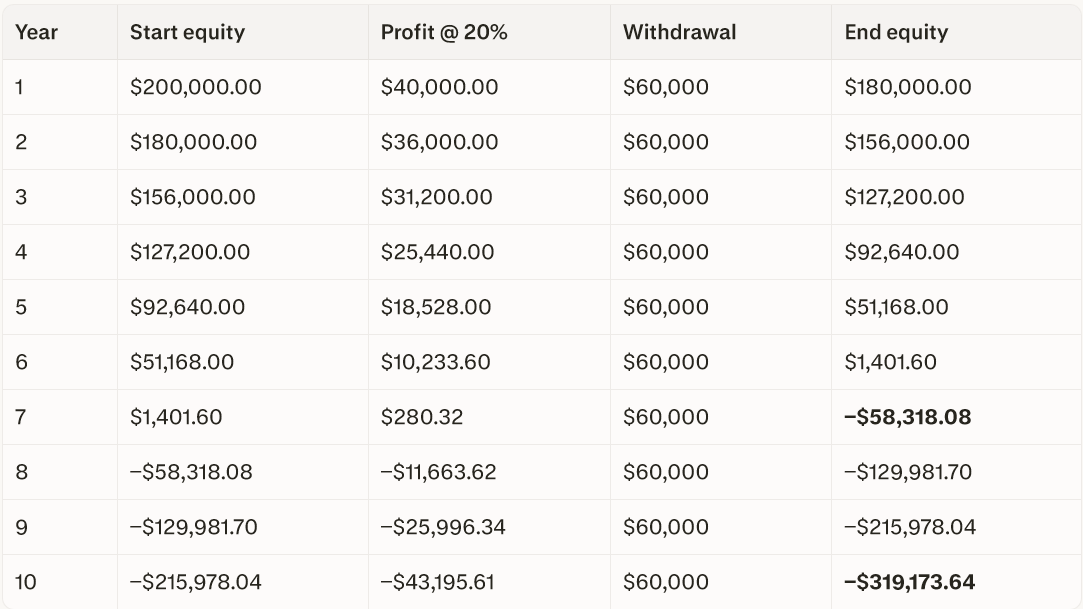
You’d use up your account in 7 years...
A fixed dollar withdrawal that is too big relative to capital and edge will destroy the account.
And this simulation is based on the assumption that you will earn a 20% return every year.
Which won’t happen.
“even legendary trader like Stanley Druckenmiller, with a annualised return at 30%+/yr for 30 straight years (without a losing yr) may not have self-rewarded any withdrawal at the beginning years of his career to maintain such astronomical return over the long stretch”
Jeff Sun
You’ll have better years and worse years.
And in 10 years, you’ll have at least one year where you break even, or even worse, a year where you lose money.
And think about it: many people don’t have that $200,000.
And ask yourself if $20,000 is enough.
Maybe it is for day trading.
BUT
Don’t despair,,,there’s still a way!
What should you do?
You have 3 options:
increase your performance or
find another source of income.
reduce your living expenses
Both are good options.
But the easiest one is to build another source of income and reduce your living expenses.
By its very nature, swing trading gives you more time.
Time you can use to start a part-time venture.
That way, you won’t overtrade and you’ll let your account compound.
AND
There’s another hidden benefit.
WHEN YOUR INCOME DOESN’T DEPEND SOLELY ON TRADING
you’ll be mentally freer and able to risk your capital more effectively.
It is much harder to improve your performance than to find another revenue stream.
Join 2,000+ traders
For less than $0.80/day, unlock a proven swing trading strategy, real-time trade alerts, and access to a private Discord community.
So now that I’ve defined that, I want you to understand that there’s a difference between:
Trading for a living and trading full time.
It’s much harder to trade for a living because you need a minimum of 1 million in capital.
Another question that probably comes to mind is:
After how long of profitability should I quit my job?
I said I’d tell you later what’s more important than capital.
Well, it’s: Profitability.
If you’re not profitable, you have no reason to quit your job and trade full time.
Why would you?
It will ruin you mentally, emotionally, and socially.
Instead, I recommend a minimum, an absolute minimum, of 6 months of profitability.
So you can get through 2 quarters.
But to be honest, even that’s not enough.
I’d say two years of profitability is a much better track record.
Personally, I quit my job after almost three full years of profitability as a swing trader and several more years as an investor.
You also want to have savings covering at least two years that you can fall back on in case your full-time trading doesn’t work out or you have a bad year.
That way, you won’t have to dip into your initial swing trading capital.
And take my word for it.
It really does affect you mentally.
Even though we’re in a massive bull run, in 2026 it wasn’t easy for me to execute trades.
Because money becomes scarcer, and you start to adopt a very conservative mindset.
Which comes with two sides to it.
ALSO
This is something almost nobody talks about, but it matters more than you think.
Fix your personal life before going full time trading
If your life is chaotic, your trades will reflect that.
If your financial situation is unstable, you’ll feel pressure with every decision.
If your relationships are strained, this will affect your focus and emotional control.
Trading is, in and of itself, already mentally demanding.
When you add personal stress to the mix, it becomes exponentially harder to stay disciplined and consistent.
You need stability outside the charts to be able to perform well within them.
That means:
Having your expenses under control.
Not being in constant financial stress.
Having a clear routine and structure to your day.
Being in a good mental and emotional state.
Because once you commit to trading full-time, there’s no turning back.
You can’t blame a job, a boss, or external circumstances.
It all comes down to you and your decisions.
And if your foundation is weak, trading will expose it very quickly.
Now that you’ve checked off all these points, there’s just one more thing you need to get started
Equipment & Tools for Swing Trading
I didn’t start with this because it’s the most obvious thing.
You need a good chair to sit in for hours.
Don’t skimp on this one.
You need a desk.
And at least one monitor.
I personally have two monitors. I don’t think I need more than that.
But I couldn’t have done what I do with just one monitor.
Also,
Don’t skimp on your internet plan.
You need a good, fast internet plan.
As for tools, you’ll need:
- a trading journal
- charting/scanner software
- a good broker.
That’s it.
These will probably cost you around $2,000 in total.
You’re now ready to start swing trading full-time, or part-time if you still don’t have the required capital.
This isn’t easy for most people.
Not like it’s portrayed online.
Unfortunately, the reality is that you can’t start full-time with 10k, or even 100k.
But that shouldn’t discourage you.
You can start anytime while holding down a job.
Work hard.
Be consistent.
And your dream will come true.
I know this because I’m living it.
You just need to start
Look, I didn’t write this to discourage you.
I wrote it because I wish someone had been this honest with me before I made the leap.
If you’re serious about building toward that freedom, whether you’re still working a job or already trading part-time, PRO is the next logical step.
You’ll get the structure, the accountability, and the real-time insights that most traders never get to see.
And right now is the best time to start.
The yearly plan is 49% off. If you’ve been sitting on the fence, this is the moment.
See you inside.
Trade Setups of The Week
High Probability Trades for 14-18 September 2026

This week’s PRO report breaks down my full momentum stock watchlist, including the setups I’m watching.
You’ll see my portfolio, my open positions, and the exact stocks I’m targeting.. all based on the same swing trading system.
If you want to trade smarter ,not longer , and get my weekly watchlist with setups, and portfolio breakdowns, this one’s for you.
If you think this newsletter could help your friends, share it with them so it can reach as many traders as possible.
And here’s the fun part: when you share it, you can unlock special rewards + you will look smart in front of your friends :)
“One trade closer to freedom.”
Vladislav
The most important variable may actually be the one outside the trading account: how dependent you are on monthly P&L to pay living expenses. Once rent depends on the next few trades, the exact same strategy becomes psychologically different. I’d personally size much below 5% account risk per trade, the first objective of going full-time should be reducing risk of ruin, not maximizing the speed of compounding.
Good article because it looks at trading as a real life calculation, not just a return target.
If you want to trade full-time, you need more than trading capital. Health insurance, taxes, retirement savings, education, holidays and the missing employer contributions all belong in the calculation.
20% per year is a strong return. But it is still an average. Some years will be lower, some may be negative, and your life still needs funding during those years.
That is why simulations like this are useful. They take the topic out of wishful thinking.