


If your account has taken a hit in the last few weeks, this one is for you.
The Nasdaq (QQQ) closed on November 3 about 10% below its October 6 high. Breakouts failed, stops were triggered, and maybe one loss is still weighing on your mind.
If you’ve suffered losses recently, this article is for you.
First of all, don’t be too hard on yourself.
Even those who’ve studied this their whole lives and have an entire team behind them lose.
Long-Term Capital Management had two Nobel Prize winners on its team: Robert Merton and Myron Scholes.
In 1998, it lost $4.6 billion in less than four months.
The New York Fed had to bring 14 banks and brokers into one room, and together they contributed $3.6 billion so the fund wouldn’t drag the entire market down with it.
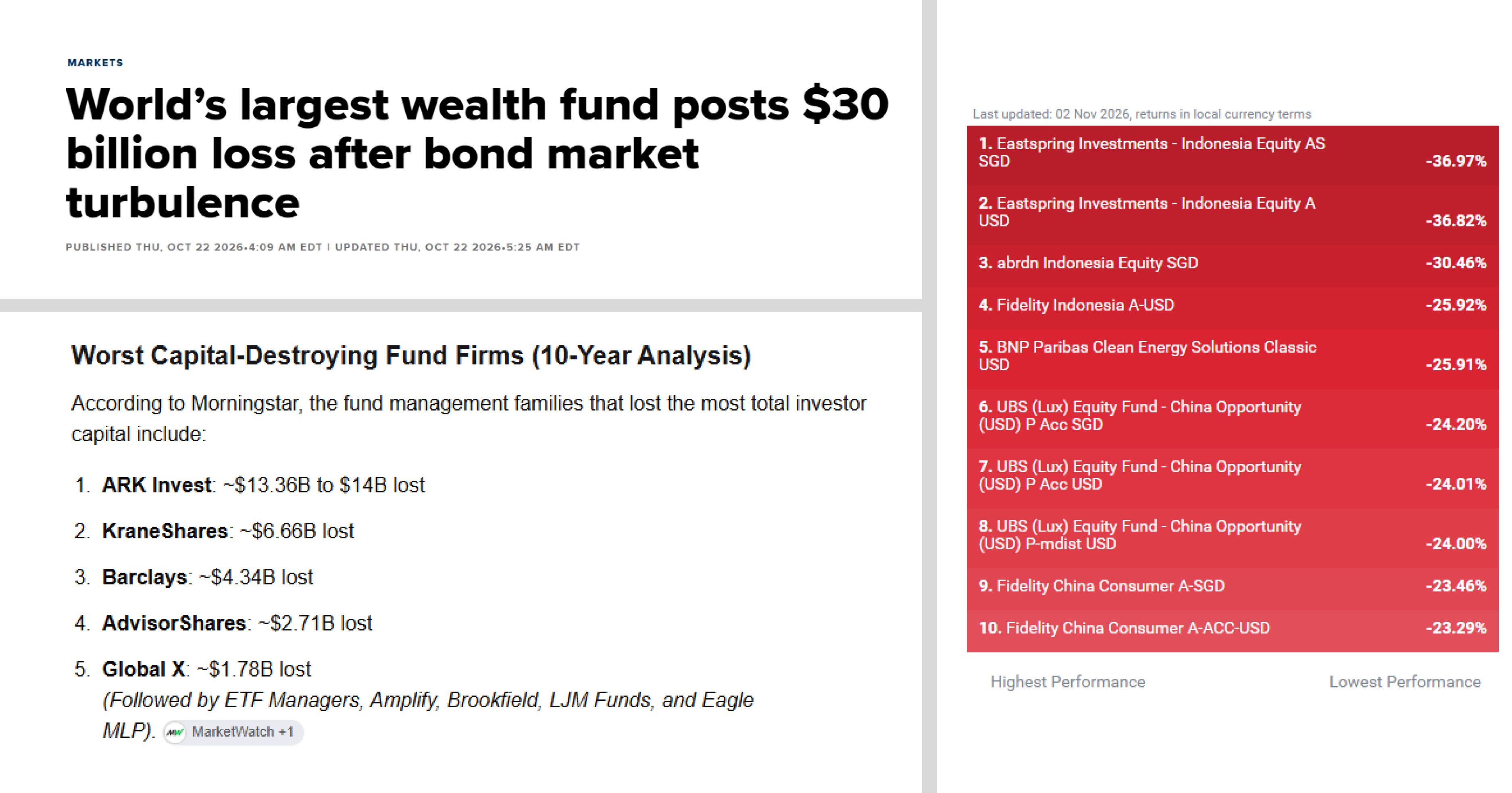
And it doesn’t only happen in history books. On October 22, the world’s largest sovereign wealth fund (Norway’s) reported a $30 billion loss for the quarter.
By the end of this article, I’ll tell you exactly how I cope with losses, both mentally and from a risk management perspective.
So next time, you’ll be better prepared to take on the stock market.
So, what do I do when a loss happens?
First of all, I want you to really get it through your head that losses are inevitable.
There is no way to avoid them.
Just like in life, it’s no different in the stock market.
You will lose…and you’ll lose often.
That means the first thing I work on is accepting that loss.
Step 1: Accept the loss
…because naturally you’ll want to “GET YOUR MONEY BACK.”
That will be your first instinct.
And that instinct leads to revenge trading.
So, I take a break, step away from the screen, and accept the loss.
Once I’ve done this, I move on to step two.
Step 2: Analyze the loss
I have two journals:
—a digital journal (which automatically logs all my trades and compiles them on a platform so I can view the statistics)
—and a physical one (where I write down my thoughts, ideas, etc.)
If the loss is part of the plan and is a normal one, it goes into the digital journal, and often there isn’t much to do about it, because it’s part of the strategy’s normal variance.
As I was saying, losses are normal and inevitable.
But you’ll realize that over time.
At first, you should analyze every trade.
HOWEVER.
If that loss isn’t a planned one, let’s say I lose 2R or even 3R due to a gap down.
I’ll probably note this in my physical journal, where I write down a lot of things about how I feel, what I felt before, during, or after the trade.
Basically, my goal is to identify the real cause of this loss.
To see if there was anything I could have done better.
And to prevent future bad decisions from compounding.
I’ve been keeping physical journals since 2019, and I can tell you it’s changed my life.
I 100% recommend it!
If you don’t know what to write, start with these 7 questions after every big loss:
1. Was this trade in my plan BEFORE I entered?
2. Did I respect my stop and my size? If not, where did I break the rule?
3. How much did I lose? In R and in % of my account.
4. What was the market doing? Index above or below the 50MA, and how my last 10 trades went.
5. What did I feel before, during and after? FOMO, boredom, the need to make money back…
6. What kind of loss was it? Normal variance, a setup mistake, or an execution mistake.
7. What’s the one thing I’ll do differently next time?
Once I’ve truly internalized the loss from both perspectives, the psychological and the mechanical, I move on to the next step, which is
Step 3: Rebalance your risk
Because I’ve accepted that I don’t want to recoup my money immediately, and because the market is unfavorable for my strategy right now or my performance has declined, I’ll reduce the size of my positions.
If there’s one thing I want you to remember from this entire article, it’s this:
Do not double your position size after a loss.
Losses and gains don’t work the same way.
Lose 10%, and you need a +11.1% gain to break even.
Lose 50%, and you need a +100% gain.
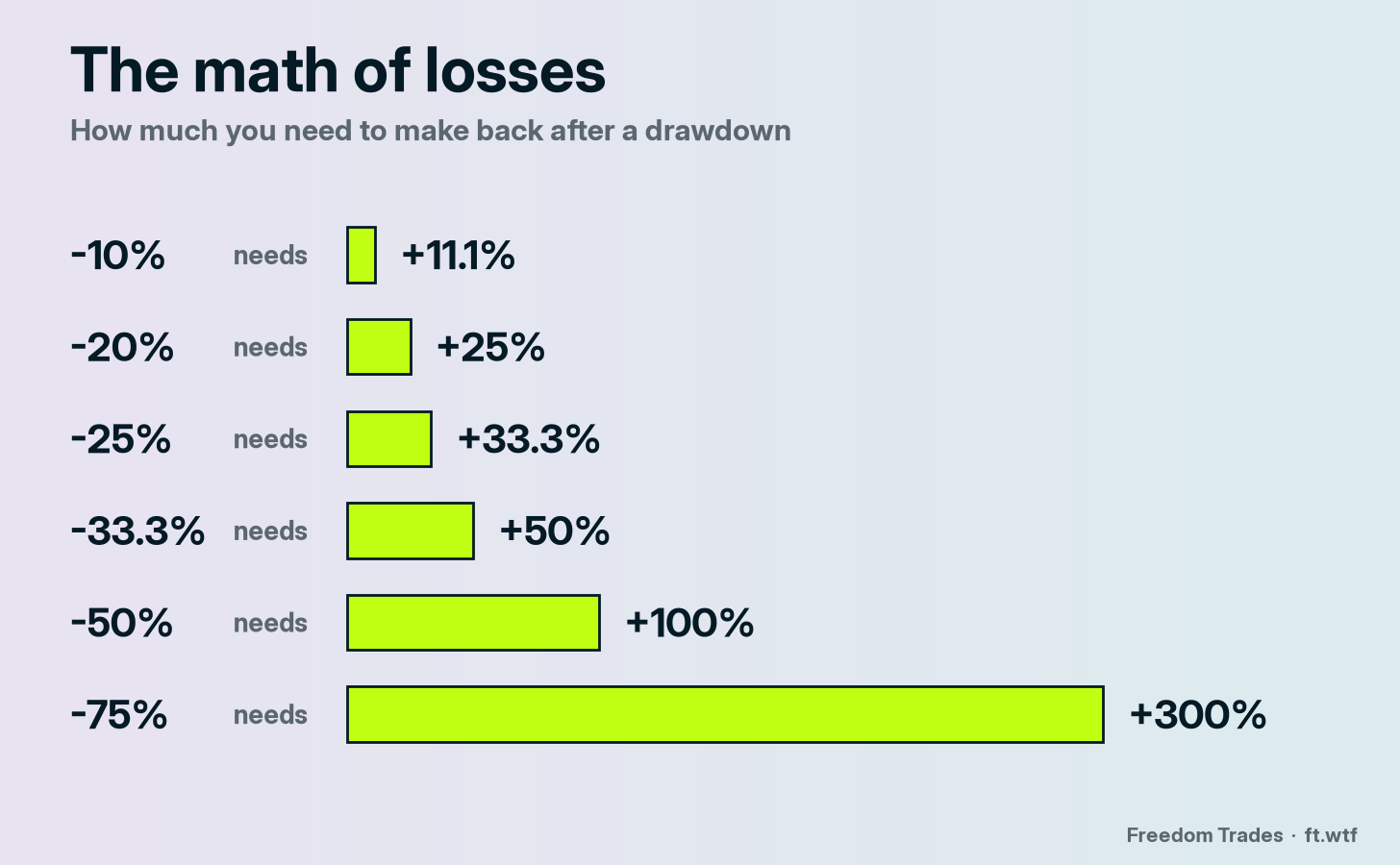
The deeper the hole, the harder the climb. So the first job after a loss is to stop digging.
Now look at what size does to the same losing streak. Five losses in a row, starting with 1% risk per trade:
Double the size after every loss: -28.0% (you need +38.9% to recover)
Keep the same size: -4.9% (+5.2% to recover)
Cut the size after losses: -2.5% (+2.5% to recover)
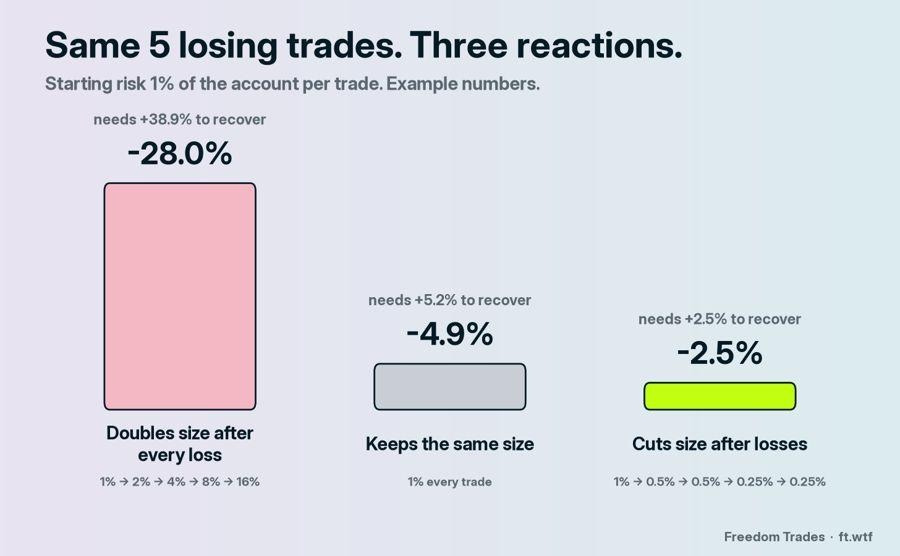
I know this is your first instinct (which stems from not accepting the loss, by the way :).
I’ve been there.
But you probably lost because:
the market isn’t favorable to your strategy (it will take time for it to recover, reduce your position size)
your performance has declined (it will take time for your confidence to return, reduce your position size)
you gambled; there’s no real strategy (it will take time until you have one, reduce your position size)
All the reasons why you lost boil down to one solution: reduce your position size.
Paul Tudor Jones said it in *Market Wizards*:
“When I am trading poorly, I keep reducing my position size. That way, I will be trading my smallest position size when my trading is worst.”
And do you know when it’s time to size up and return to your normal position?
Well, that’s why it’s important to go through Step 2, namely, analyzing the loss.
Because if you know what the problem is, you’ll know when it’s been resolved.
If it’s the market environment, you’ll return to your normal position once the market becomes favorable.
Here, you can use a simple filter, such as whether the market is above the 50MA or not.
But the best indicator is still your PNL, when your latest trades start to pay off.
Mark Minervini has this in his rules too:
“Only trade large on the heels of smaller trades working” and “Always trade progressively smaller when trades aren’t working”.
If your performance is the issue, work on consistency, and you’ll know exactly when it’s time to push further.
The point is, don’t skip step 2, identify the problem first ,and you’ll know when it’s fixed and you’re ready to increase the volume.
How to Get Through TRADING REHAB
So, to survive the trading rehab “program,” you must:
Accept the loss.
Analyze the loss (once you’re ready to do so).
Take steps to manage risk.
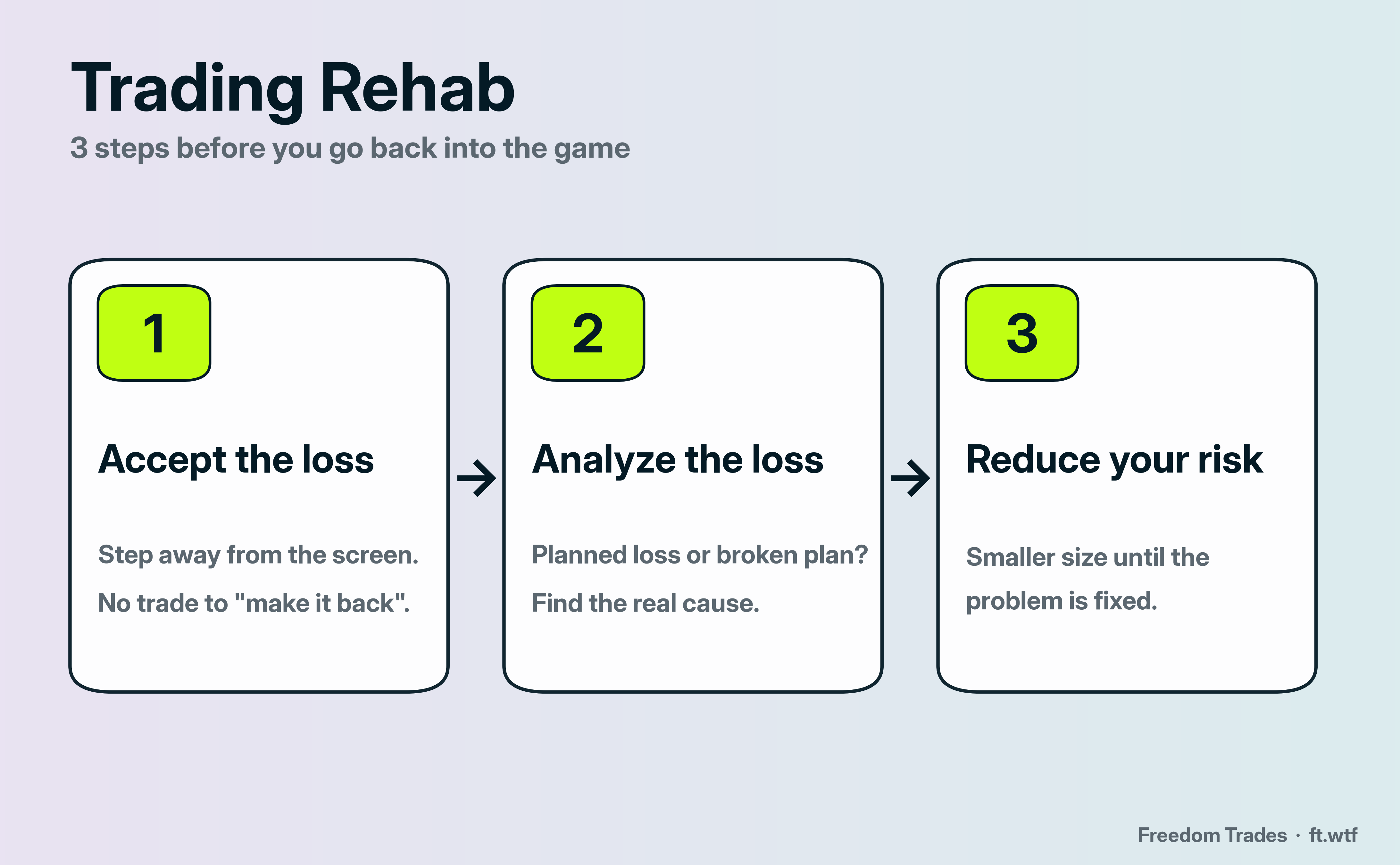
Once you’ve gone through these three stages, you’re ready to get back in the game.
You’ll notice that this framework works in real life, too.
That’s pretty much how we get through trauma as well.
And just know that bouncing back from a loss is a lot easier when you’re not doing it alone.
That’s why I invite you to join the Freedom Trades community.
Join 3,000+ traders
For less than $0.80/day, unlock a proven swing trading strategy, real-time trade alerts, and access to a private Discord community.
What counts as a “big loss”?
A normal loss is 1R, the amount you planned to lose when you set your stop. If you risk 0.5% of your account per trade, a normal loss is exactly that. Part of the job.
A big loss is anything that breaks the plan:
More than 1R on one trade: a gap down through your stop (that’s how 1R turns into 2R or 3R), or a stop you moved “just this once”.
A streak that adds up: five or six normal losses in a row can take your account below its high.
A loss that changes how you trade: you keep thinking about it, and all you want is to make it back. Today.
The third one is the most dangerous, because it leads straight to the next mistake.
I hope this article was helpful, and I look forward to seeing you in the community.
Trade Setups of The Week
High Probability Trades for 2-6 November 2026

Just like last week, I urge you to stay in cash, this is not a risk-on environment, and it’s definitely not the right environment to buy breakouts.
If you think this newsletter could help your friends, share it with them so it can reach as many traders as possible.
And here’s the fun part: when you share it, you can unlock special rewards + you will look smart in front of your friends :)
“One trade closer to freedom.”
Vladislav
The LTCM story with the $4.6 billion loss in under four months puts a QQQ pullback of about 10% in perspective. Dips like this are exactly where a written review process pays off.