


One of the coolest people on Substack wrote this on our Discord Server a few days ago.

In the search to improve how I react to monetary losses in trading, I started digging into studies and trying to understand the psychological effects of losing money.
When I was a beginner, I hated how I reacted after a losing trade. Not the loss itself. The spiral after.
This article is the result of that research and my conclusion.
I’ll list all sources at the end of the article.
I want to start from the premise I saw in this video.
That our relationship with money starts as early as age three.
Basically, multiple studies by neuroscientists and financial therapists have shown that:
Kids start building a money story around age three.
Because they watch the parents.
They watch your face when you open your bank app.
They hear your tone when you say “We can’t afford it.”
They feel the stress when money shows up in a fight.
And their brain does what brains do best.
It builds a script.
A money script is a simple rule your brain learns early, then runs on autopilot later.
Stuff like:
Money is scary.
There is never enough.
Rich people are greedy.
Money solves everything.
Saving is a virtue.
Wanting profit is shameful.
That’s why adults can make more money than ever and still feel broke.
Or have a solid income and still panic when they invest.
Or win in the market but feel guilty for wanting more.
If you grew up with stress around money, you’ll carry stress around money into adulthood.
If you grew up with money as a fix for everything, you might seek comfort in that.
So my conclusion from this is: everyone starts from a different place in life.
And we also have different limiting beliefs.
So start by analyzing your relationship with money, because that’s your real starting point.
Your strategy should be aligned with your character and the relationship you have with money.
When money equals self-worth, stress hits harder
In another study, using a sample of 389 participants, researchers found:
“When we asked people to write about a financial stressor, they experienced a drop in their feelings of autonomy,”
“They also showed more disengagement from their financial problems, they gave up searching for solutions. We didn’t find this in people who didn’t tie their self-esteem to financial success or among those who were asked to write about an academic stressor.”
In those essays, the researchers also coded the type of language participants used to describe their financial problems.
“We found that people who highly based their self-worth on financial success used more negative, emotion-related words, like sadness and anger,”
That’s the part traders hate to admit.
When your self-worth is tied to money, a red day doesn’t feel like data.
It feels like you.
So what happens next looks like “bad trading,” but it’s really a stress reaction:
You move stops.
You size up to get it back.
You start clicking just to feel in control.
The damage it does to your brain
Another interesting study is Mani et al. (2013, Science), which showed that:
Money-related pressure can consume mental bandwidth and reduce cognitive control (executive function), hurting performance.
Can you imagine that?
Financial worries consume mental resources in real time, reducing executive function and the ability to make good decisions.
That can lead to mistakes, procrastination, bad decisions, and a vicious cycle that keeps people stuck.
So if you already have financial problems when you start trading, and then you hit a drawdown after taking consecutive losses, you’re at a massive disadvantage.
Naturally, your brain starts making even worse decisions like:
-not respecting the stop loss
-taking more size
-overtrading
In plain English: money stress eats mental bandwidth.
Less bandwidth means worse decisions.
Worse decisions create more stress.
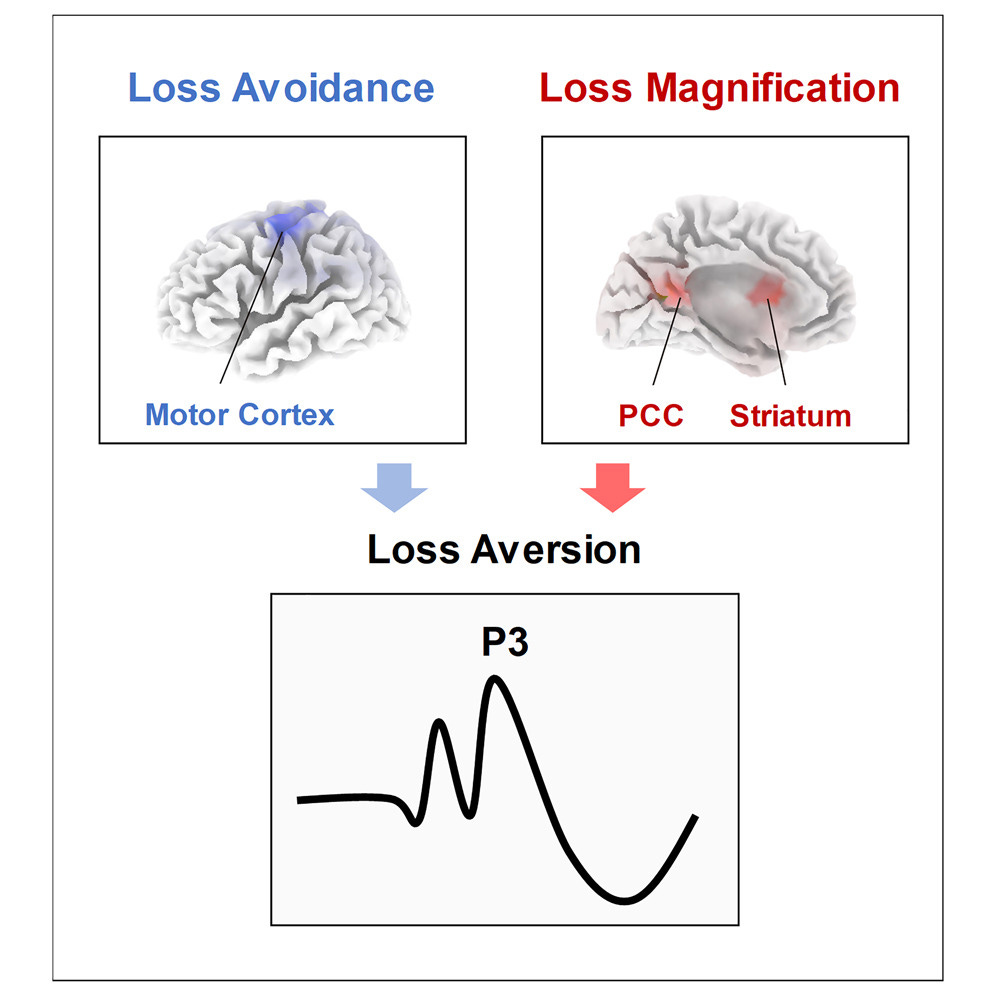
Loss aversion
Three specific brain regions become activated in situations involving loss aversion.
The amygdala is the part of our brain that primarily processes fear, creating an automated, pre-conscious sense of anxiety when we detect danger.
The second brain region engaged by loss aversion is the striatum, which is responsible for calculating prediction errors and anticipating events.
Finally, our brain’s insula area reacts to disgust, working with the amygdala to encourage us to avoid certain types of behavior.
Though there are many other parts of the brain that contribute to this cognitive bias, these three regions are vital to understanding the neural basis behind how we process and respond to loss.
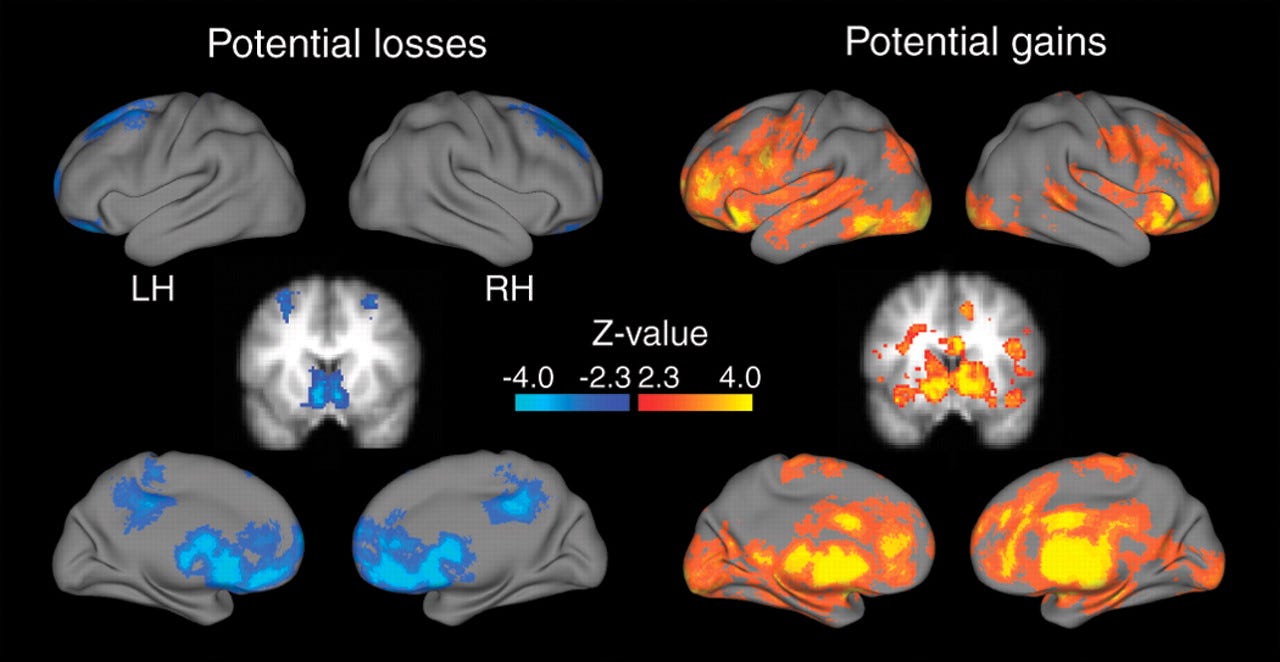
Loss aversion shows up most clearly in how we manage money, because financial choices spill into every part of life. When decisions aren’t made with a clear, measured process, the downside is rarely limited to the portfolio.
Many people hesitate to buy a stock when there’s a real chance of loss, even if the upside is meaningful.
What’s worse is that loss aversion tends to intensify as the stakes rise. That bias pushes investors to hold losing positions longer than they should, or to avoid strong opportunities simply because the possibility of being wrong feels too costly.
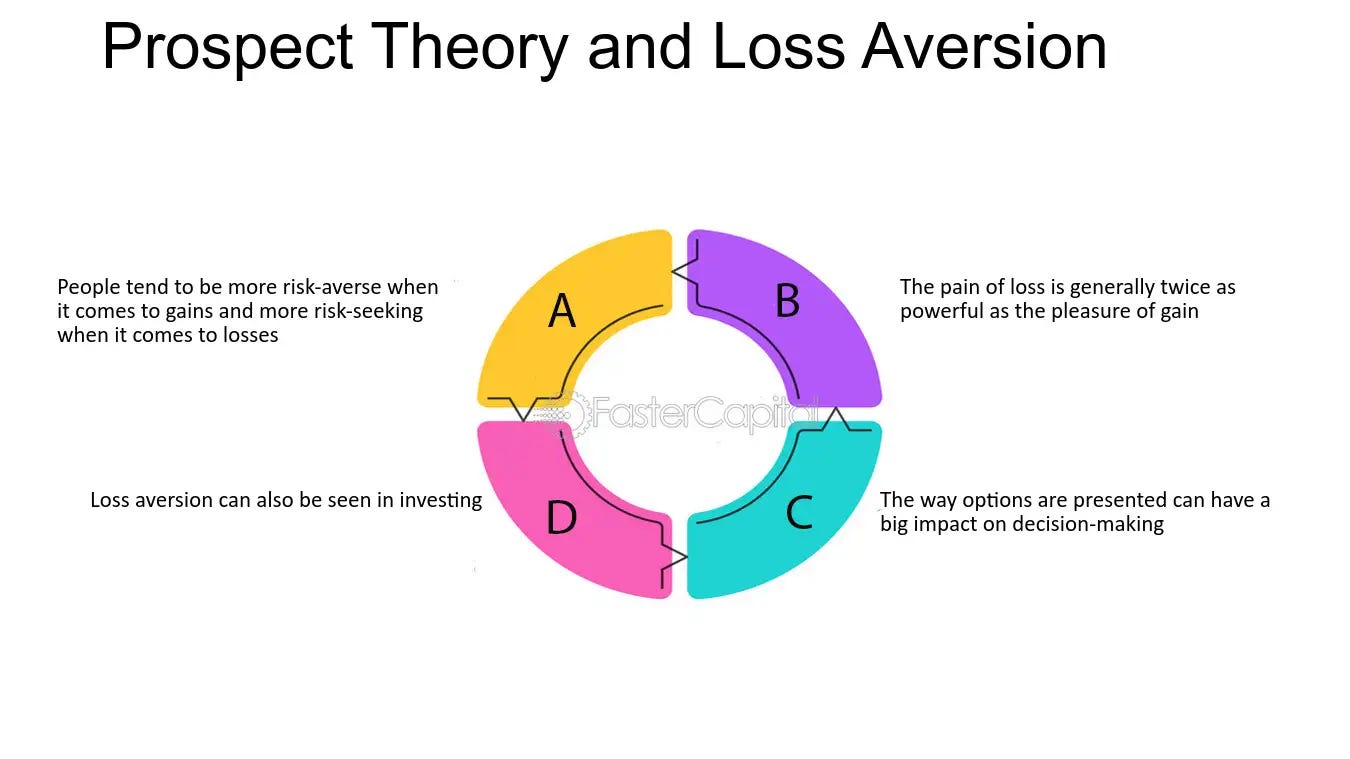
Over time, it can also distort priorities, nudging people toward short-term comfort at the expense of long-term growth.
This is the logic behind myopic loss aversion: protecting yourself from near-term pain can quietly create a bigger problem later.
The solution is a system.
If your mind is the thing that gets hijacked, then your plan must remove as many decisions as possible.
A system gives you repeatable outcomes.
That’s the whole point of Freedom Trades.
I shared my full strategy and risk management plan because having clear rules to follow on your worst day will save your trading account.
Action steps you can do this week
Start with one goal: make your next 20 trades boring.
Pick one setup only.
One entry trigger.
One stop rule.
One position sizing rule.
If you don’t have those written down, your “strategy” is just vibes.
Here’s a simple framework you can copy.
Pre-define risk before you enter
Set a fixed risk per trade. Example: 0.25% to 1% of your account.
Your stop decides your size.Use a stop rule that does not move
Place the stop where the trade idea is invalid.
If you move the stop, you are not managing risk.Track expectancy so you can trust the system
Write down 20 trades and calculate:
win rate
average win
average loss
If your system has positive expectancy, a loss is just one rep in the gym.
Remove decision points with:
Bracket orders.
Auto-attached stops.
Alerts for entries.
The more clicks you need under stress, the more mistakes you’ll make.
A quick mindset shift that actually works
Stop asking: “How do I feel about this loss?”
Start asking: “Did I follow the system?”
If yes, it was a good trade, even if it lost.
If no, you found the real problem.
That’s how you get consistent!!
If there’s one thing I learned from all this research, it’s simple:
Most people blow up their trading accounts because their brain gets hijacked.
And when that happens, you don’t need more; you need fewer decisions and a system to rely on.
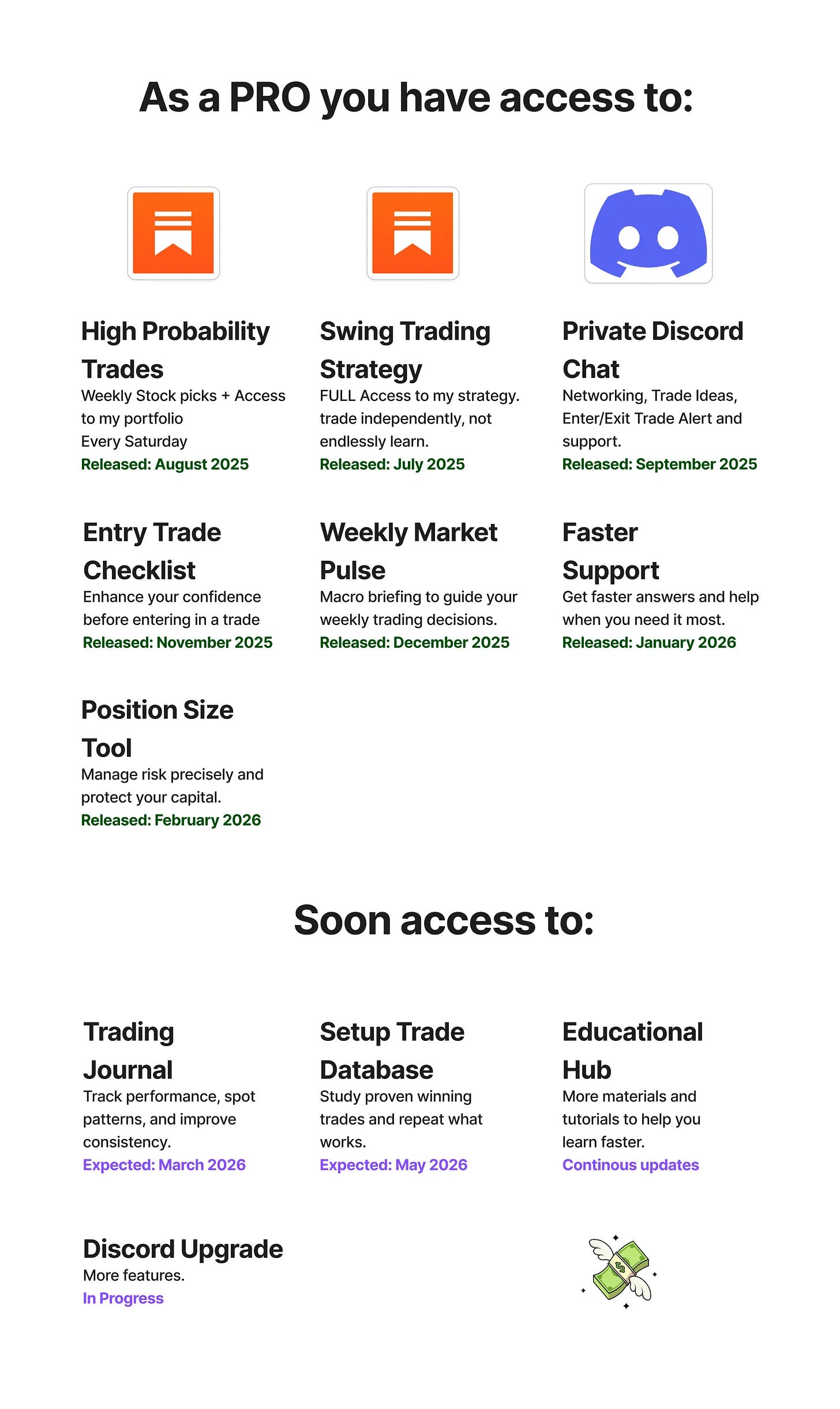
That’s what Freedom Trades Pro is for.
Trade Setups of The Week
The Next Big Sector Rotation ?

This week’s PRO report breaks down my full momentum stock watchlist, including the setups I’m watching.
You’ll see my portfolio, my open positions, and the exact stocks I’m targeting.. all based on the same swing trading system.
If you want to trade smarter ,not longer , and get my weekly watchlist with setups, and portfolio breakdowns, this one’s for you.
Source:
Link: - Your money trauma starts at childhood
https://www.cell.com/iscience/fulltext/S2589-0042%2824%2901378-6
https://www.science.org/doi/10.1126/science.1134239
https://www.buffalo.edu/research/about-us/researcher-spotlight.host.html/content/shared/university/news/ub-reporter-articles/stories/2017/05/park-self-worth-money.detail.html
https://shafir.scholar.princeton.edu/sites/g/files/toruqf4226/files/povertyimpedescognitivefunction.pdf
https://finhealthnetwork.org/research/understanding-the-mental-financial-health-connection/
This newsletter could help your friends; share it with them so it can reach as many traders as possible.
And here’s the fun part: when you share it, you can unlock special rewards + you will look smart in front of your friends :)
“One trade closer to freedom.”
Vladislav
This is a great write up, very well written! Thanks for considering my comments and questions in the discord.