


Today I’m sharing the most powerful lessons from the trader who turned $5,000 into $106 million.
His name is Kristjan Kullamägi, better known as Qullamaggie.
These are my notes after reading Market Wizards by Jack Schwager.
Trading Lessons from Qullamaggie
Qullamaggie is the trader who inspired a new generation of retail traders.
He showed the world that it’s possible.. that you can come from any corner of the planet and still achieve financial freedom.
He proved you can make millions through hard work and a bit of brainpower.
How did Kristjan Kullamagi started trading?
Kristjan Kullamägi’s interest in trading began while working as a security guard at Nasdaq Stockholm, leading him to pursue it with intense commitment despite early inexperience.
He blew up three accounts before becoming consistently profitable on his fourth attempt, eventually transitioning from day trading to swing trading with greater success.
Over a decade, he grew a $5,000 account to over $100 million, even while regularly withdrawing funds.
However, in 2022 he lost more than half his account due to rule-breaking during a market downturn, later reflecting on his mistakes with honesty and humility.
Qullamaggie’s favorite setup is the Episodic Pivot.
He describes the key components of an Episodic Pivot as follows:
“The three ingredients for an episodic pivot are a major news item, a big gap up, and a huge increase in volume. When all three conditions are met, a stock can experience an explosive price move, especially in a bull market environment.”
Kristjan Kullamagi
As you know, EPs are also part of the setups I have in my own playbook.
To catch them is actually very simple:
Create a screener with the following filters:
Price > 4 USD
Mkt cap 300M to 2,000T USD
Registration: United States
Price x vol > 50M USD
SMA, 200 < Price
Pre-mkt gap > 8%
ADR > 5%
EPS dil growth, TTM YoY > -800% (optional)
And you’ll watch this scanner in the pre‑market.
This way you’ll also avoid low‑quality setups and penny stocks.
I like to trade only stocks that are trading above the 200‑day moving average.
I consider “EP quality” stocks to be those that open with at least a 10% gap up.
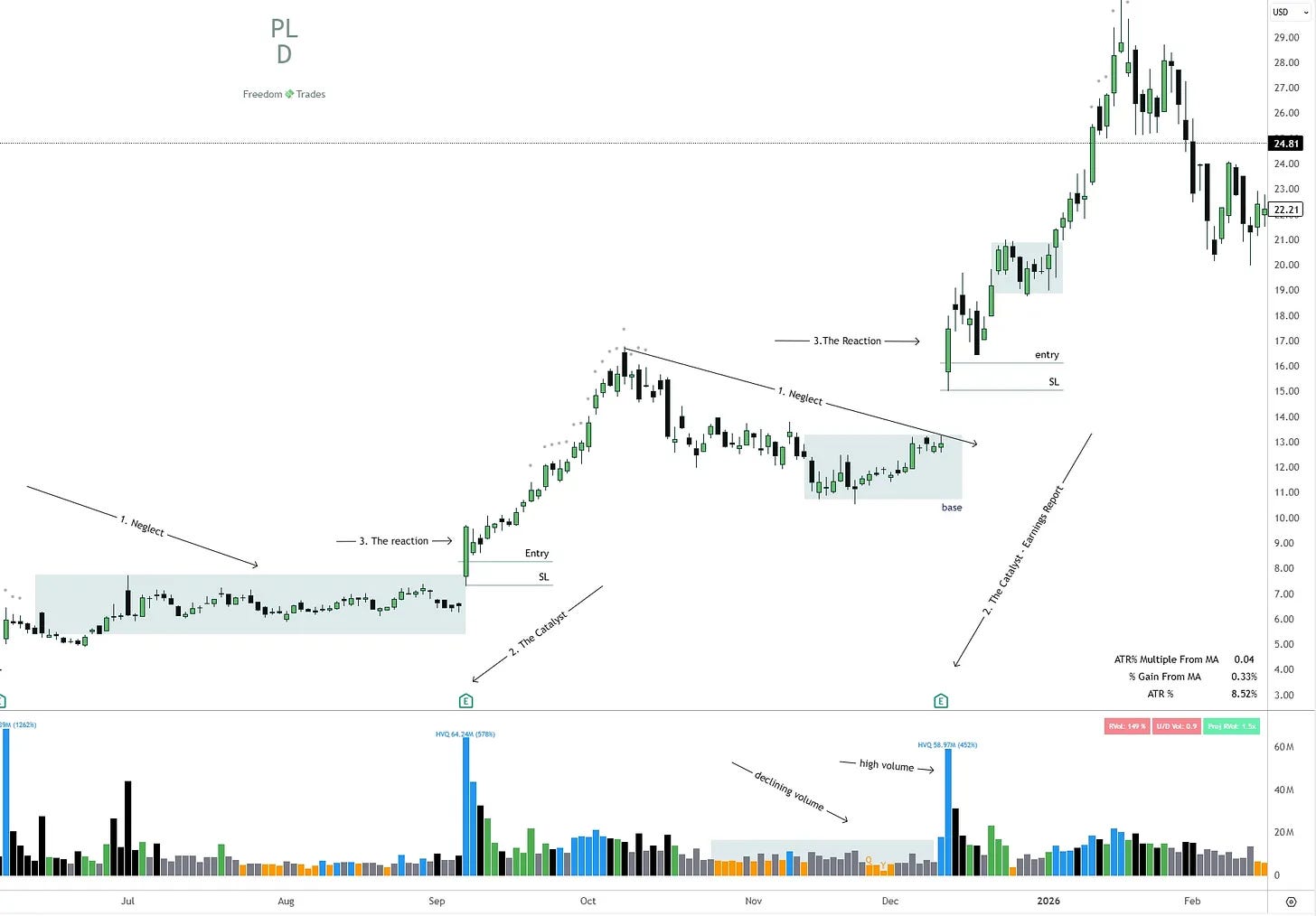
“The best episodic pivot trade is a neglected stock. Ideally, you want a stock that has been going sideways for a long time—months, even years—and then suddenly, it has 10 times its average daily volume.”
Kristjan Kullamagi
Here Kristjan is referring to bases, you know the saying: “the bigger the base, the higher in space.”
When you look at an EP, you want to see on the chart that the stock has just broken out from a base.
You don’t want to see an erratic chart that’s just whipping up and down.
Here’s an example of the kind of structure you want to see:
“when stocks make explosive moves, most of the move is over in three to five days.”
Kristjan Kullamagi
That means he likes to trim into strength.
A good way to do that is to sell one‑third of your position during the first 3 to 5 days after the EP has occurred.
“you want to focus on leading stocks. One way to identify those stocks is to scan for the 1% or 2% stocks with the largest upmoves in the past one, three, and six months.”
Kristjan Kullamagi
Usually, the stocks that experience episodic pivots are the ones that are already leading stocks.
What he means is that you have a much higher probability that the trade will be a winning trade if it’s a leading stock in a group that has strong momentum.
To identify them, again, you simply create a scanner sorted by 1‑, 3‑, and 6‑month performance.
Personally, I like to use only the 1‑month combined with the 3‑month performance — that way I capture the more recent leaders.
“you can enter on a price move above the opening range or above the high of the first 5-, 30-, or 60-minute bars. The longer the time range used for the entry signal, the worse the entry price, but the lower the risk of entering on a false breakout.”
Kristjan Kullamagi
Kristjan is referring exactly to the tactic I use in Freedom Trades, namely the opening range breakout.
Here’s an example of a 5‑minute opening range breakout:
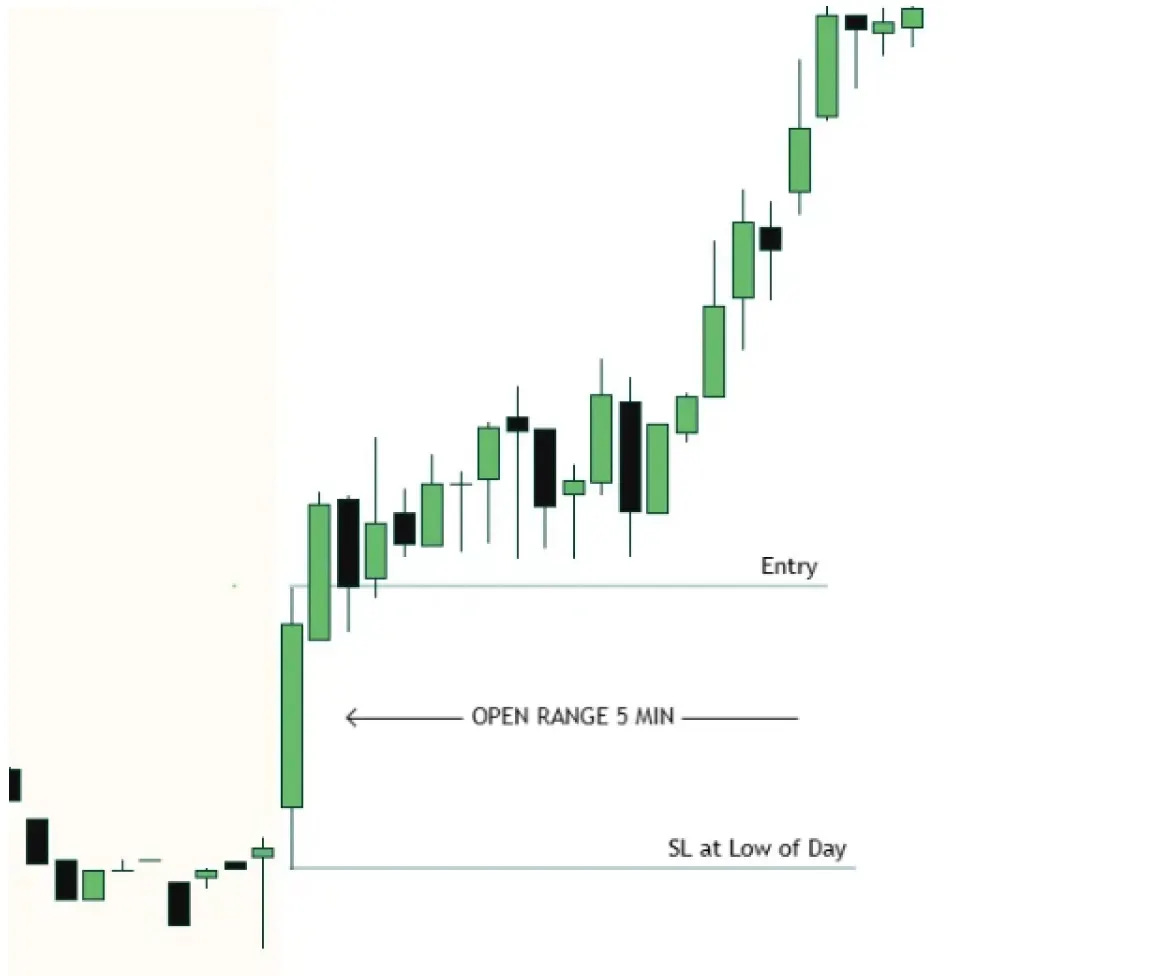
He is making a very important observation: the longer the timeframe you use, the higher the probability that the trade will work out.
However, there’s also a downside: you will get a worse entry, and sometimes the trade can take off without you and become overextended.
He also says:
“the market direction is crucial for breakout and episodic pivot trades. Four out of five stocks move with the market. You want the odds on your side.”
That means you need to have situational awareness when you’re buying a stock.
You don’t just buy it blindly because it broke out.
If you want to increase the probability that the trade will work, you need the general market to be moving in the same direction.
Because we already know from William O’Neil that three out of four stocks move in the direction of the overall market.
Join a community of swing traders united by a single goal: Freedom! +2,918% cumulative return (Jan 2024 – Jan 2026)
Holding positions for longer is where the big gains come from. Stocks take time to move. If you want to catch the big moves, you need to increase your time frame.
Kristjan Kullamagi
I have the same philosophy, and that’s why I’m a swing trader.
I believe what really moves the needle in your account are multi‑week runners that compound your equity over time. But for that to happen, you need to hold your positions longer.
In day trading, you take advantage of the repeatable small price fluctuations, whereas in swing trading you’ll catch a bigger move with lower stress.
Plus, you won’t be forced to stare at the screens all day.
“Typically, I will risk 0.5% or less of my account size per trade, but I may risk up to a maximum of 1% on some trades.”
Kristjan Kullamagi
All of those massive gains were achieved while risking less than 1% per trade.
Contrary to what most beginner traders believe, you don’t have to full‑port your account into 0DTE to get massive gains.
Sure, it’s not going to happen overnight, but you’ll definitely sleep better at night.
I even built my own dynamic risk cheat sheet, and it looks something like this:
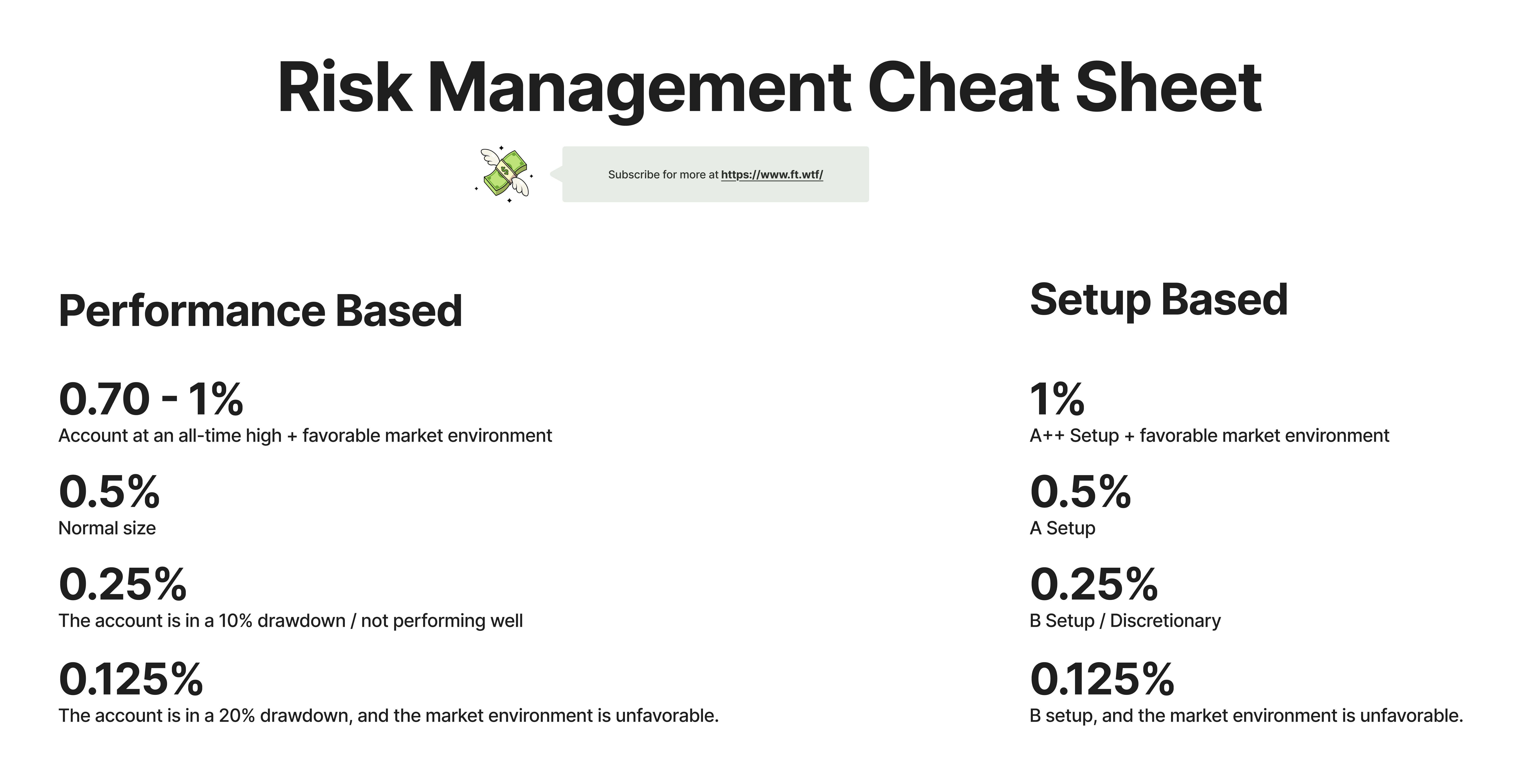
You have to remember that it’s not a bad trade that will make you blow up your account … it’s your position size.
That’s why they say: “Price will hurt you, position size will kill you.”
So structure your position based on how much you want to risk per trade.
What really helped me and impressed me was his take on trading psychology in this section:
“I started 2020 with $3.5 million and ended the year at $36 million. It was a thousand percent year. Then I ran that $36 million to a high of $105 million, and the last portion of that move from $65 to $105 million occurred in just a month and a half. For a brief period, just a few days, I was over $100 million. You have to understand what that did to my psyche. It made me feel completely detached from reality. I thought, “I’m going to get to $200 million in six months.” I was completely sure of that. I started seeing trading as a video game, which I kept winning. I lost a lot of money because I got completely detached from my methods.”
Kristjan Kullamagi
For me, this was extremely powerful, because trading really does this to you.
The biggest losses tend to come right after the biggest wins.
What happens when you win is you become careless.
This is exactly what happened to me in January: coming off a hot streak in 2024 and 2025, I wanted to push hard into the beginning of 2026, a mistake I’m still paying for halfway through 2026.
Filled with the euphoria of those gains, you start to go a bit blind.
You start bending your rules a little at first, you become obsessed and dependent on winning.
And in trading we know that the best loser wins, you have to accept loss as part of the game.
But when you win a lot, you start believing that the hot streak will last forever.
The way Kristjan managed to get through that big loss was by reminding himself where he started and how much progress he’d made up to that point.
“Sometimes, when I felt miserable, I would remember where I came from and where I was now.”
One thing that kept running through my mind while I was reading all this was the question:
What is the secret behind Kullamagi’s success?
Well, he does give us an answer…one that probably won’t be very popular with everyone.
“When I learned to trade, I was in my early 20s, single, and had no responsibilities. I could put in 60 to 80 hours a week for a decade. That’s how I made it.”
Kristjan Kullamagi
It’s “simply” outworking everyone else.
I put “simply” in quotation marks because there’s nothing easy about that.
“I want to look at the trades that worked to reinforce what I should look for.”
Kristjan Kullamagi
He spends tens of hours studying charts, studying what the leaders did, how they moved before they exploded, and which charts showed real relative strength.
That’s what all of us have to do: over time, our brain starts to get better at spotting the right patterns and the right price action.
That’s how we learn, we first observe, then we apply what we observed, and that’s how we build experience.
There has to be substance underlying the belief in yourself.”
I want to leave you with one more lesson that Kristjan teaches.
When asked what else contributed to his success, Kristjan answers:
“Find a mentor—a successful trader who can guide you in learning setups. Trading is hard to figure out on your own. Most people never do. A mentor will help you solve a lot of problems right out of the gate.“
Kristjan Kullamagi
I strongly believe that a mentor, a community, or even a trader who’s at the same level as you can help you speed up the process.
First of all, you’ll have accountability and support from people who may already have been through what you’re going through now.
That’s exactly why I created the Pro Membership.
I didn’t want people to spend years figuring everything out alone the hard way, blowing accounts, repeating the same mistakes, and wondering why the big moves keep slipping away.
Inside the Pro Membership you get:
Access to the exact setups I trade (including the Episodic Pivots and Opening Range Breakouts we just talked about)
Daily trade signals with exact entry and stops.
My full focus list every morning before market open
Access to 100+ members who trade this same swing trading playbook
If you are thinking about joining the community, right now is the best time to do it.
The yearly plan is 49% off.
See you inside :)
PS: I highly recommend reading Jack Schwager’s new book.
It’s packed with insights and lessons, even more than those from Kristjan, and it also includes charts you can study while the trader explains each concept.
They’ve personally helped me a lot in my trading career.
Trade Setups of The Week
High Probability Trades for 3 - 7 August 2026

This week’s PRO report breaks down my full momentum stock watchlist, including the setups I’m watching.
You’ll see my portfolio, my open positions, and the exact stocks I’m targeting.. all based on the same swing trading system.
If you want to trade smarter ,not longer , and get my weekly watchlist with setups, and portfolio breakdowns, this one’s for you.
If you think this newsletter could help your friends, share it with them so it can reach as many traders as possible.
And here’s the fun part: when you share it, you can unlock special rewards + you will look smart in front of your friends :)
“One trade closer to freedom.”
Vladislav
This was a fantastic post.. I watched his videos years ago.. He was a very impressive trader..
Do episodic pivots still work ? Have you checked.