


I’ve known Lukas since 2023, back when he gave an interview for the “Chat with Traders” podcast.
What initially drew me to him was his broad perspective on both the market and life.
I couldn’t believe this guy was in his twenties.
And that’s due to two factors, in my opinion:
starting early in life. (He started trading when he was just 13 years old.)
a life full of challenges, as he himself says: “Suffering can be a great motivator.”
Today I’m sharing the most powerful lessons from the trader who made millions in just few years.
According to market wizard book From January 2020 through December 2025, Lukas compounded at an average annual rate of 309.3%, while keeping maximum drawdown to 35.5%.
Lukas has for sure one of the most extraordinary performance records in modern retail trading.
These are my notes after reading Market Wizards by Jack Schwager.
Trading Lessons from Lukas Frohlich
Perhaps the biggest “secret” to finding alpha (or the so-called “edge”) is revealed right at the beginning of the interview, when he is asked how he decides what to buy or sell.
Lukas answers between the lines:
“I don’t mind volatility and chaos in the markets because I think that is where mistakes are made, which creates opportunity.”
Lukas Frohlich
He is referring to the fact that traders can identify market inefficiencies here and exploit them.
Many shy away from volatility as it can seriously damage your account.
However, volatility often reveals the emotions of market participants, and emotions do not represent calculated decisions; they are inefficient, they lead to errors, and this is not likely to change anytime soon.
How Lukas Frohlich Got Started in Trading
Early in his career, Lukas would short small-cap stocks that gapped up sharply.
What set him apart from others in this field was that:
“ I analyzed SEC filings, identifying companies with an impending working capital problem. I also analyzed news releases that caused the stocks to rally to determine which were bogus and which might indicate a turning point for the company.”
Lukas Frohlich
He placed short trades based on his own research and used stop-loss orders to limit losses.
When asked how he chose his stop-loss levels:
“I had multiple ways of stopping out. Sometimes I would use a new daily high as a stop. Other times, I would set the stop a certain percentage above my entry price. I also used standard deviation-based moves above the opening price as a stop—a method I was fond of because it adjusted to market volatility.”
Lukas Frohlich
But the interesting part is that he doesn’t get stuck in the “small-cap stocks” space like most traders do.
It’s interesting because I know how difficult it is to adapt and keep learning once you’ve found success in a particular area.
But he’s not like everyone else, he manages to recognize that scalability becomes an issue once your account grows past seven figures, and in 2020, he shifted his focus to mid-cap stocks.
And that’s what I want to talk more about here, since we mainly swing trade mid-cap and large-cap stocks.
The mid cap era
What makes it even more impressive is that, for mid-cap stocks, he uses breakouts on the long side.
Imagine you’ve been used to going short your entire career, you even have “The Short Bear” as a nickname, but you don’t let that define you, and you do a complete 180-degree turn toward the long side.
“The mid-cap breakout trade is a specific strategy that works during strong bull markets and outperforms almost anything in the 7th–9th inning of a bull market, during the euphoria phase.”
Lukas Frohlich
He manages to identify the bull market that is taking shape in 2020, the biggest opportunity in the last 12 years, and capitalizes on the investors’ euphoria..
“I traded stocks with a market cap in the $1 to $5 billion range, since these are the stocks that tend to move the most when they move. I also preferred stocks with smaller floats, as smaller floats mean greater potential for explosive upmoves.
I focused on themes and stories that were being hyped on social media.”
Lukas Frohlich
If you look at my previous post, where I talked about how I find the next winners, that’s exactly the approach Lukas uses.
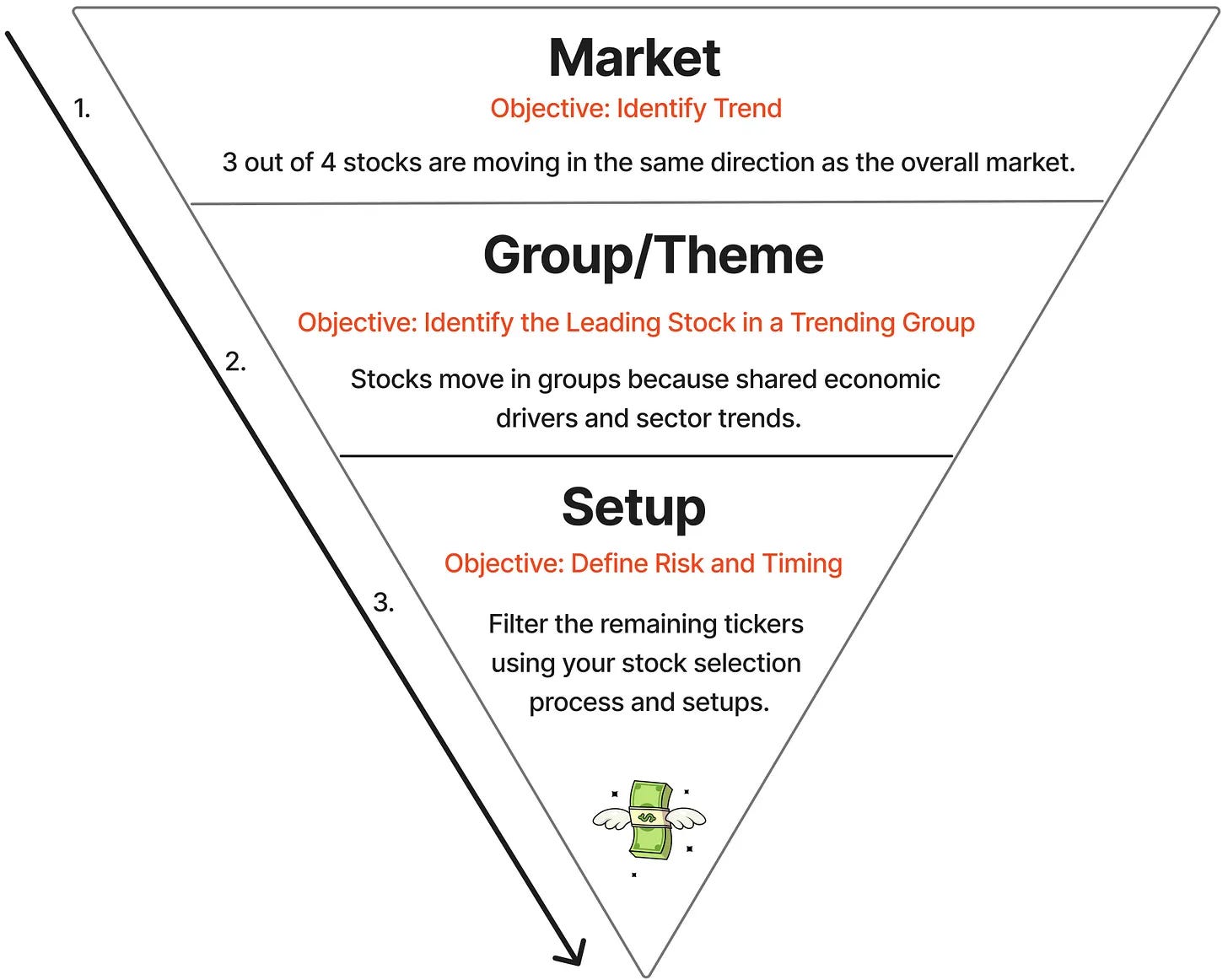
He is aware of the market environment (the euphoria phase) and knows it’s time to push.
Then he identifies the themes and sectors that are in an uptrend.
Next, he filters stocks based on his setups; he prefers stocks valued between 1 and 5 trillion because they have enough volume and liquidity for him to enter with his account, and smaller floats because they have greater potential to skyrocket.
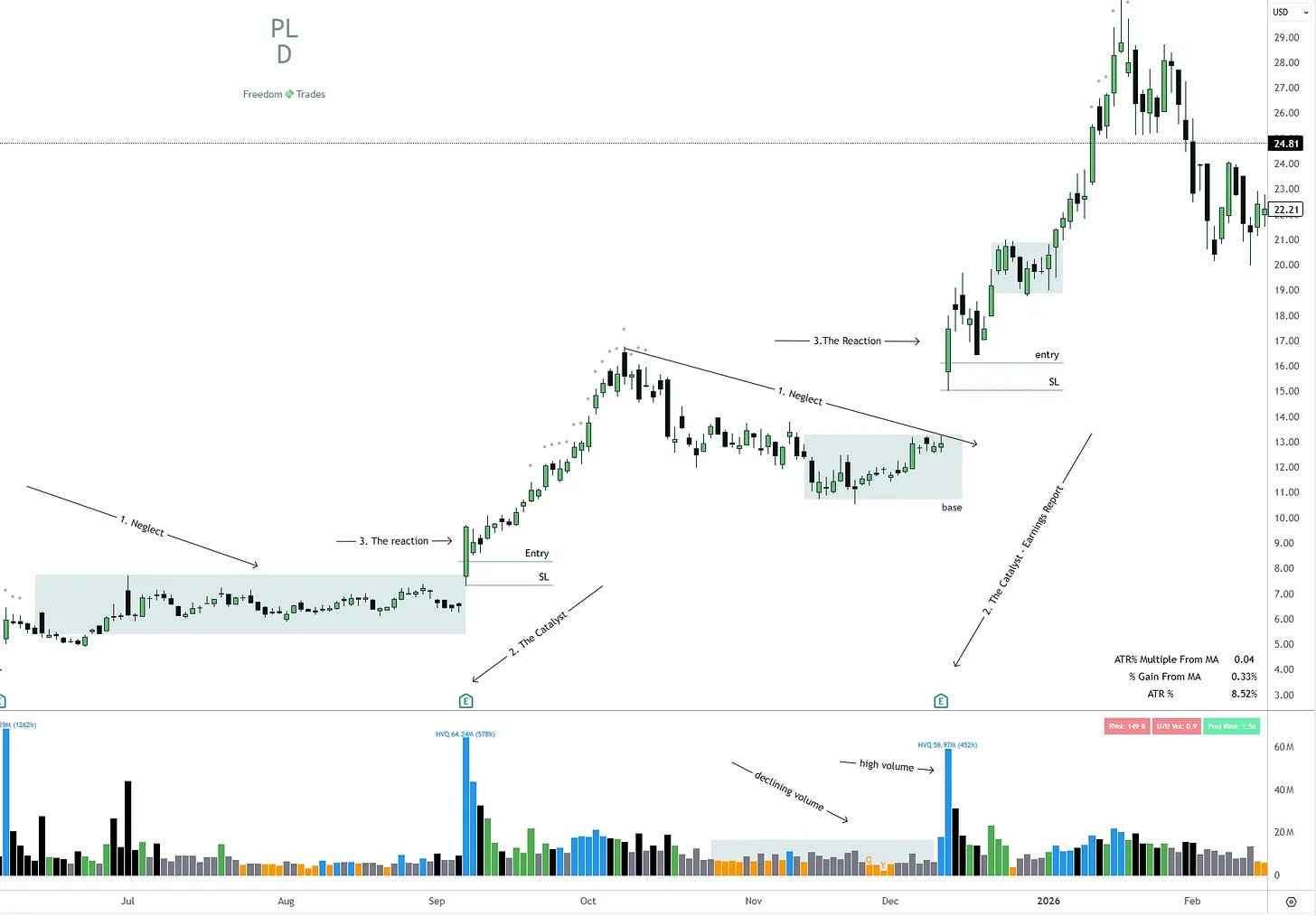
I wanted to see the stock consolidate for a while before heading to new highs. Ideally, the stock would trade in the upper 50% of the consolidation before breaking out.
Lukas Frohlich
This is pretty much what a stock should look like before it skyrockets.
Join a community of swing traders united by a single goal: Freedom!
+2,918% cumulative return (Jan 2024 – Jan 2026)
And Lukas doesn’t buy just any stock simply because it meets his stock criteria.
No, he looks for a catalyst.
There are many potential catalysts: a positive earnings report, the company rolling out new products, favorable government policy, and so on.
To increase the likelihood that this trade will be successful, you need relative volume. And that relative volume often comes hand in hand with a catalyst.
Another very important filter for me is the 200MA.
You often send me all kinds of tickers and ask for my opinion.
As long as that ticker is below the 200MA, don’t touch it. There’s no trade.
If you study the tickers that have seen the biggest gains in recent years, you’ll notice that the majority of the move happened above the 200MA.
So you won’t lose anything, in fact, it’ll save you from trouble, just as Lukas says:
if you wait to buy until the price gets above the 200-day moving average, you can reduce the likelihood of getting into big trouble.
Lukas Frohlch’s entry, stop-loss, and take-profit strategy
One thing I personally think I should work on more is adding to my position.
What’s interesting here is that Lukas uses pyramid positioning
“Typically, I tried to start with about two-thirds of my intended position.
When my initial entry was pre-breakout, I often used the breakout as a spot to add a pyramid position.
I used pullbacks to the 20-day EMA as entry points. I also added within a new consolidation that might form after an upswing.”
So he starts small, and then adds to his position incrementally as the price moves in his direction.
His goal is to be at the beginning of a major trend. And if he succeeds in doing that, he can significantly increase the size of his position.
If a new setup presents itself within the trade, Lukas isn’t afraid to add to his position, as he’s prepared to sacrifice his initial profits if the trade doesn’t work out.
I would add the amount of stock such that if the stop was hit, the loss on the added position would exactly offset the remaining open profits on my prior long position at that point.
if a pyramid addition didn’t work as expected in short order, the entire trade would be dead to me, and I would get out.
When asked where he puts the brake, Lukas replies
If I were buying within a consolidation anticipating an upside breakout, I would use a stop below the consolidation. If I were entering on a breakout, my stop would be below the low of the breakout day.
To take profits, I use either the 10MA or the 20MA, but Lukas uses the EMA, which is the exponential moving average that takes price action into account.
As the move progressed and I was well ahead on the trade, I would use a stop below the 20-day EMA initially and the more sensitive 9-day EMA if the move turned parabolic.
The Disadvantages of This Strategy
When he started talking about the challenges of strategy, I could totally relate.
I believe that the hardest part of the vast majority of strategies that involve a discretionary component is patience.
Being able to do nothing during unfavorable periods.
And Lukas puts it best:
“Being able to step away when the market environment is not suitable is the hard part in applying this strategy.
I used to think big money was made by being very active as a trader, but now I believe it’s made by sitting on winning positions.”
I’d like to wrap up with a little motivation from Lukas and how he managed to get through the tough times in his trading career:
If you don’t have the willpower to fight through the pain, you shouldn’t be a trader. That’s harsh, but I believe it is true. I personally had two primary motivators that carried me through the hard times: a fear of not amounting to much and a fear of having someone over my head that would dictate my life.
Lukas Frohlich
Lukas isn’t just a trader with extraordinary results, he’s living proof that discipline and adaptability beat raw talent in the long run.
He started shorting small-caps at age 13, then had the courage to admit when his strategy was no longer scalable and make a complete 180-degree shift to going long on mid-caps, right in the midst of market euphoria.
What strikes me most about him isn’t the 309% annual return, but his mindset: “Big money is made by sitting on winning positions.”
In a world where everyone wants to do something every day, he tells you plainly: big money is made by having the patience to let good trades run.
For him, trading isn’t just about money… it’s about freedom.
Join 2,000+ traders
For less than $0.80/day, unlock a proven swing trading strategy, real-time trade alerts, and access to a private Discord community.
Trade Setups of The Week
High Probability Trades for 3 - 7 August 2026

This week’s PRO report breaks down my full momentum stock watchlist, including the setups I’m watching.
You’ll see my portfolio, my open positions, and the exact stocks I’m targeting.. all based on the same swing trading system.
If you want to trade smarter ,not longer , and get my weekly watchlist with setups, and portfolio breakdowns, this one’s for you.
If you think this newsletter could help your friends, share it with them so it can reach as many traders as possible.
And here’s the fun part: when you share it, you can unlock special rewards + you will look smart in front of your friends :)
“One trade closer to freedom.”
Vladislav